Sustainability Management Committee
The Sustainability Management Committee was established under the Board of Directors to discuss general policies and management issues related to sustainability management. The Chief Sustainability Officer (see below), as well as other relevant executives and employees, participate in this committee. The Board of Directors and the Supervisory Management Committee supervise the Sustainability Management Committee, discussing reports on the outcomes of their committee meetings as needed. Matters related to environmental and social risk management are discussed at the Risk Management Committee , under the board of directors. Depending on the content and purpose of the discussions, these matters are also discussed at management level within various consultative bodies.
Chief Sustainability Officer
The Bank appoints two Chief Sustainability Officers (Co-CSuO) responsible for overseeing and implementing sustainable management. The officer in charge of corporate affairs and officer in charge of business affairs work together for sustainable management, stronger risk management, and related business opportunities in light of domestic and international trends.
Chief Diversity Officer
We assign a Chief Diversity Officer (CDO) to oversee and encourage diversity and inclusion initiatives.
Sustainability Advisory Board
As an advisory body to the Board of Directors, the Sustainability Advisory Board was established to consult with external experts and reflect their opinions in the advancement of our sustainability management.
Sustainability Advisory Board Members
| Name | Affiliation / Position |
|---|---|
| SATO Takafumi | Member of the Supervisory Committee, The Norinchukin Bank (Former Vice-Chairman ofthe IFRS Foundation) |
| TAKAMURA Yukari | Professor, The University of Tokyo Institute for Future Initiatives |
| TAKEGAHARA Keisuke | Professor, National Graduate Institute for Policy Studies |
| MATSUOKA Shinji | Chief Sustainability Officer, Managing Executive Officer, Meiji Holdings Co., Ltd. |
Implementing Sustainability Management through the Cooperation with Each Headquater
In order to strengthen organization-wide sustainability management, the Bank assigned HQ/Unit Sustainability Officers (SuOs)to each headquarter and unit (Food & Agriculture HQ, Retail HQ, Global Investment & Banking HQ, and Risk Management Unit).
Sustainability Promotion Structure
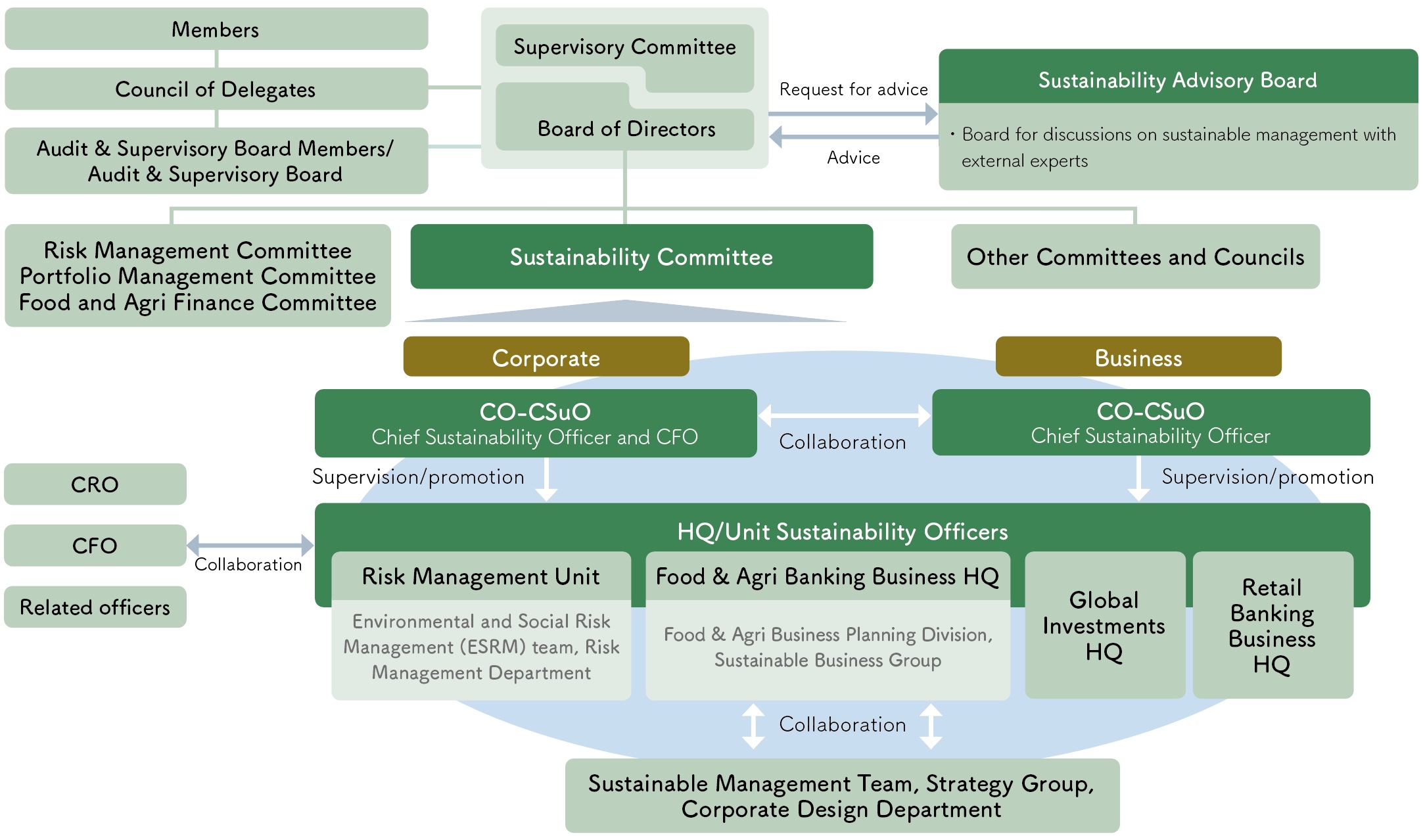
Main Meeting Bodies Handling the Bank’s Climate and Nature Issues
| Meeting Body | Chairperson | Major FY2024 Agenda Items, Discussions, and Reports (Related to Climate and Nature) |
|---|---|---|
| Supervisory Committee | Chairperson of the Supervisory Committee |
|
| Board of Directors | President and Chief Executive Officer |
|
| Sustainability Committee | Chief Sustainability Officer |
Total of five meetings in FY2024 (including those co-hosted with other councils)
|
| Risk Management Committee | Chief Risk Officer |
|
| Portfolio Management Committee, Food and Agri Finance Committee | Chief Financial Officer |
|
• The name of the Sustainability Committee was changed to Sustainability Management Committee from FY2025.
• The Portfolio Management Committee was split up into the Market Portfolio Management Committee and Credit Portfolio Management Committee from FY2025.
Message from the Chief Sustainability Officer
Managing Executive Officer (Business Administration Unit)
Chief Strategy Officer
Co-Chief Sustainability Officer
KAWASHIMA Kenji
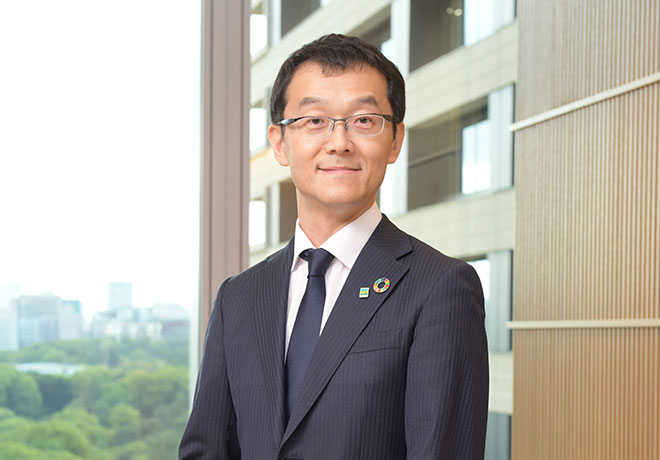
In April 2025, I was appointed as Co-Chief Sustainability Officer. When I served as the Head of the Corporate Planning Division in 2019, I set up a Sustainability Management Office within the Division as part of our efforts to make sustainability management a cornerstone of our corporate strategy. When we formulated our “Purpose” in 2021, all executives and employees came together for discussions. We defined our purpose as “Work together with our stakeholders to foster the AFF industries and to create a prosperous future for food and lifestyles, and thereby contribute to a sustainable global environment”. Like this, we have incorporated sustainability at the heart of the Bank’s management strategy.
Our medium-term vision, “Nochu Vision 2030,” lays out five goals for 2030. A key strategy for attaining them is to generate positive impacts through initiatives that link climate change, biodiversity, and circular economy.
With strong connections to climate, natural capital, and biodiversity, the Bank is a unique financial institution, both in terms of financing and operation. In light of our high dependence on nature, the impacts of climate change and potential harm to ecosystems, water, and air are important to the Bank’s management, as well as to our members, and investees and borrowers.
As a TNFD Taskforce member, we are addressing natural capital and biodiversity challenges by helping clients to start making TNFD disclosures and creating guidance for financial institutions. As Chair of the Value Chain Working Group, we also contributed to the formulation of international rules and practices.
Today, sustainability is shifting from the realm of ideals to a perspective that links it to economic benefits and tangible business achievements. We work together with primary industry stakeholders involved in food and agriculture value chains as well as midstream and downstream enterprises to advance efforts to incorporate concepts such as circular economy and nature positive in concrete business initiatives.
The Bank employs people from a wide variety of backgrounds who share a commitment to sustainability. We hope that you will continue to keep an eye on our new growth and development as an organization.
Managing Executive Officer (Value Chain Unit)
Co-Head of Food, Agribusiness and Corporation Banking
Co-Chief Sustainability Officer
TSUCHIDA Tomoko
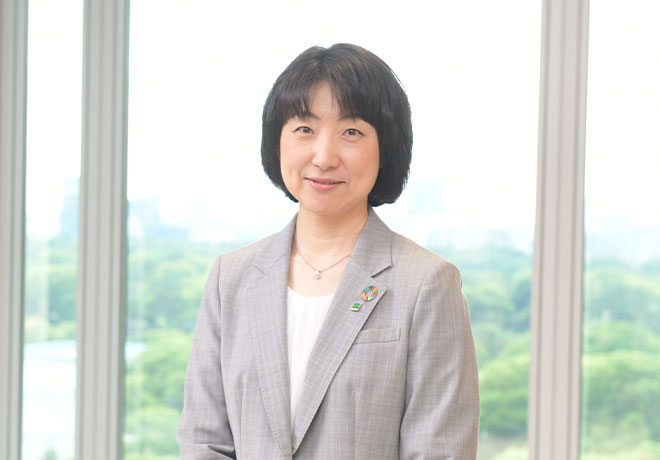
I was appointed as Co-Chief Sustainability Officer in April 2024. My job is to oversee business initiatives in line with our general policies on sustainable management.
We encourage our clients in the food and agriculture industries to tackle sustainability issues, actively exchanging opinions about the Bank’s goals and initiatives. Increasingly, we see that through their disclosures, our borrowers are gaining a deeper knowledge of decarbonization and other sustainability issues, and applying what they learn in their management strategies and business activities. They are taking these perspectives into account as they seriously consider their future business strategies, resulting in the creation of unprecedented models of collaboration, such as joint logistics systems, securing of energy resources, and local resource utilization. For its part, the Bank will co-create sustainability with its clients, not just through financial means, but also through non-financial support, such as disclosure of sustainability information, creating and procuring carbon credits derived from agriculture, fishery and forestry industries, and operating the Insetting Consortium involving all stakeholders along food and agriculture value chains.
In the field of global investment, we are aiming to achieve a cumulative total of 10 trillion-yen worth of new sustainable finance by FY2030, with a focus on improving quality as well as quantity. We have been investing in World Bank Sustainable Development Bonds, IADB Bonds (Feed Africa bonds), and similar securities. Through impact investing in the private equity sector, we aim to make a good balance between financial earning and positive impacts in areas such as climate change, education, and healthcare and welfare.
Sustainability is an issue that can never have a single, correct answer. The Bank’s strength lies in the ability to provide cross-organizational support across entire food and agriculture value chains, upstream to downstream. Keeping abreast of international trends and making use of our direct experience on the ground, we will refine our approach to lead the next wave of business together with various partners.
- Sustainability
- Sustainability Management
- Highlights of Initiatives
- Formulation of Purpose of the Bank and Milestones of Sustainable Management
- Philosophies and Policies
- Sustainability Promotion Structure
- Sustainability Advisory Board
- Important Issues to Achieve Our Purpose
- Stakeholder Engagement
- Participation in Initiatives
- Sustainable Finance
- Initiatives for Creating and Visualizing Impact
- Initiatives to Manage Environmental and Social Risks
- Agriculture, Fishery, Forestry Industries, and Regions
- Environment
- Social
- Governance
- Report/Index