As the First Call Bank for the Food and AFF industries, we work with our customers to solve challenges and create new value.
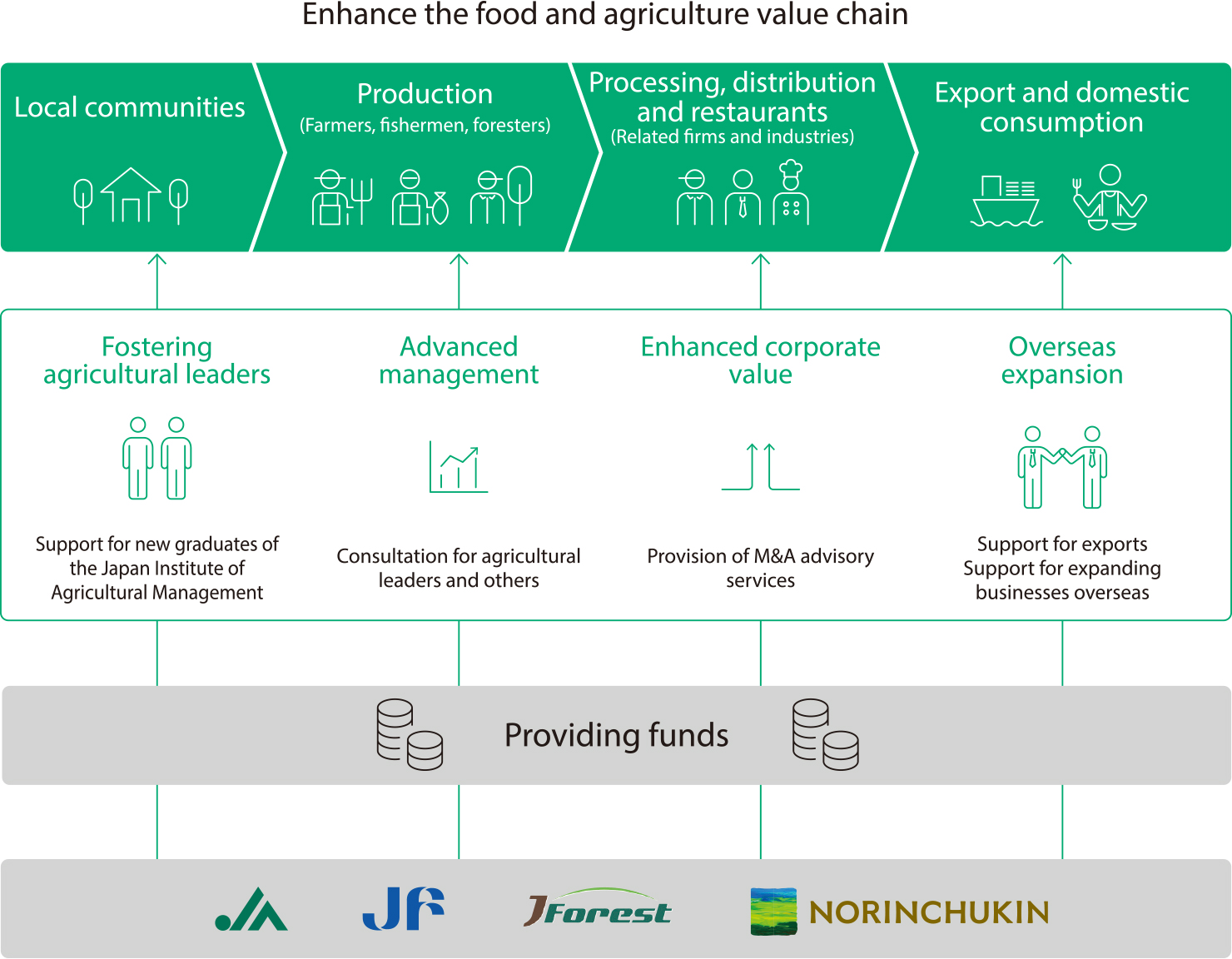
The agriculture, fishery, and forestry (AFF) industries face a range of challenges, including the decline in farmland and the number of producers, persistently high production material costs, and growing geopolitical uncertainty. Addressing these challenges requires not only supporting upstream AFF producers but also taking a comprehensive approach to the entire value chain, from the manufacture of machinery and inputs to the processing, distribution, food service, retail, export, and consumption of AFF products.
Specifically, through the Bank’s proprietary financing and investment solutions, digital transformation support and other initiatives, we will support the scale-expansion and advancement of AFF leaders and contribute to maintaining and strengthening the production base. In addition, by leveraging our broad network, we will promote the strengthening and optimization of the entire food and agriculture value chain through measures such as improving efficiency across the food and AFF-related industries and supporting exports.
OZAKI Taro
Director and Senior Managing Executive Officer
(in charge of Food & Agri Banking Business)
Member of the Board of Directors
Head of Food & Agri Banking Business
What is the Food and Agriculture Business?
Our Food and Agriculture Business is a business domain in which we fully leverage the Bank’s financial and non-financial functions centered on the business base of the JA, JF, and JForest Groups and the corporate banking business base of the Bank in order to provide a broad range of solutions across the food and agriculture value chain, from upstream to midstream and downstream.
Food and agriculture value chain
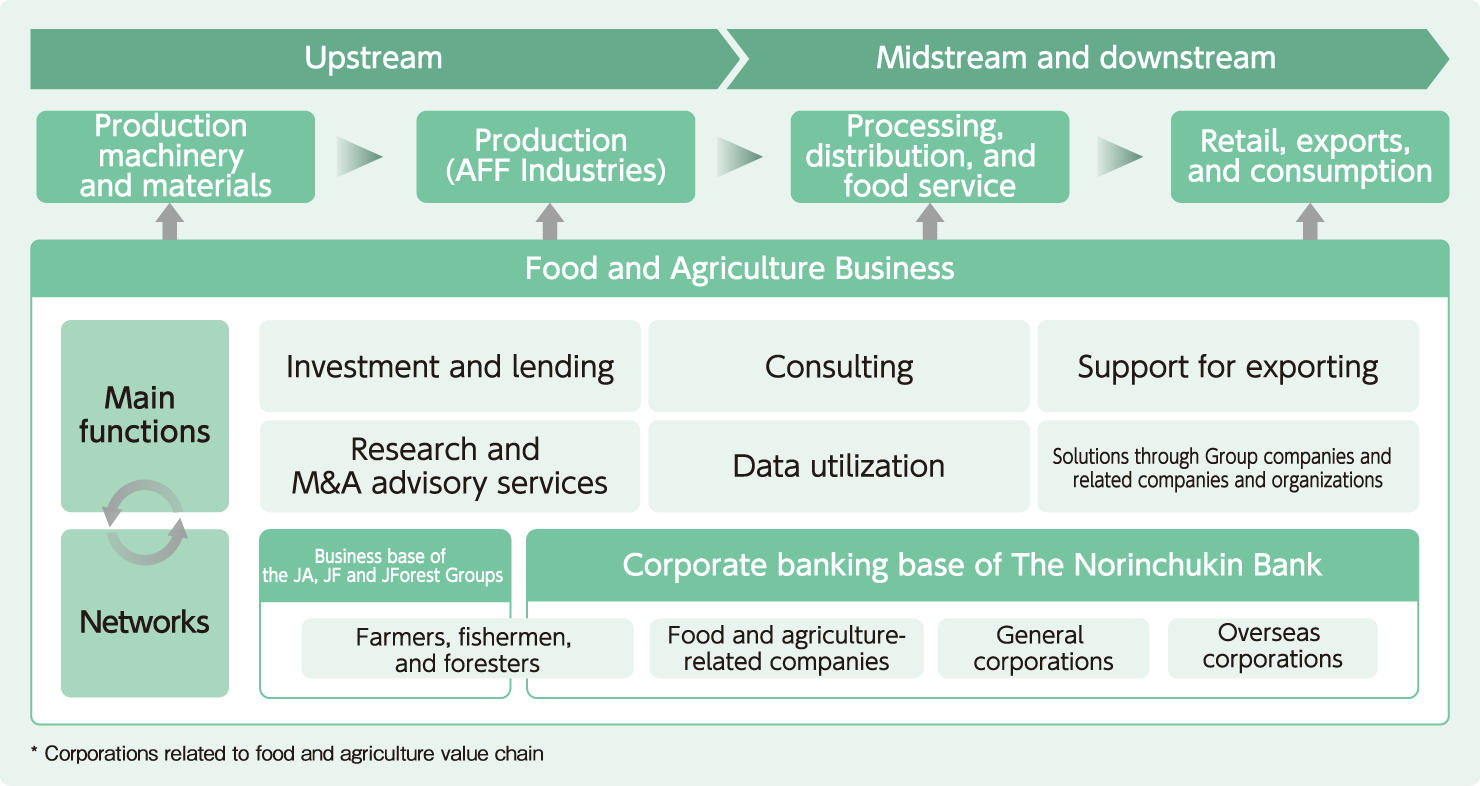
Overview of the Food and Agriculture Business

* Jointly used facilities, such as country elevators, collection facilities, and shipping facilities, that are used jointly by producers for drying, sorting, storage and processing, and other functions. The Bank recognizes that many jointly used facilities currently in operation are facing challenges, including aging equipment and infrastructure. To support the development of the AFF industries, we believe it is necessary to assist the renewal and consolidation of these facilities.
Main Initiatives in Fiscal 2025
Contribution to higher agricultural incomes
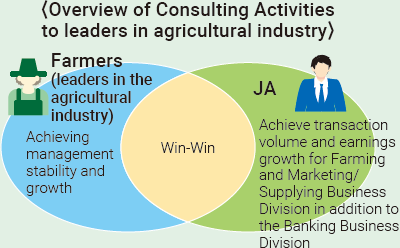
To help improve the income of agricultural producers, JA Bank, including The Norinchukin Bank, has been promoting consulting activities for leading agricultural producers. Through these consulting services, we identify management challenges, propose income-enhancing solutions, and provide ongoing support to help producers address those challenges. The Bank measures the impact of these consulting activities using the “Value-Added Contribution Amount Indicator” *.
The Bank has also been considering the provision of services in areas such as accounting and production management, which form the foundation for enhanced management visibility, with the aim of strengthening its advisory functions through the use of IT and digital technologies.
* Defined as an increase in value added (operating profit + depreciation and amortization + personnel expenses), taking into account both profit growth and appropriate investment in equipment and human resources.
What are JA Bank’s consulting activities for leading agricultural producers?
These activities are led by JA's Banking Business Division, JA Shinnoren or the Norinchukin Bank, starting off with a financial analysis and interviews with agricultural producers. After an evaluation of business viability, both quantitatively and qualitatively, then solutions are proposed to address any management issues identified.
A unique characteristic of these solutions is that they leverages JA Group's comprehensive capabilities. In coordination with Farm Guidance Division and Marketing/Supplying Business Division of JAs enables JA Bank to propose a wide range of solutions that go beyond finance. After solutions are proposed, JA Bank continues to support producers by following up on the progress of initiatives proposed for addressing identified issues.
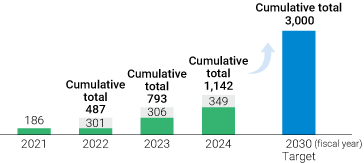
Number of consulting activities conducted by JA Bank*
Contribution to the added value amount for leaders in the agricultural industry*
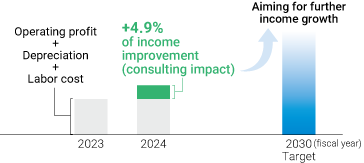
* The scope of the calculation is the cumulative total of measurable cases (144 cases) among implemented solutions in fiscal 2025 as defined in JA Bank’s consulting activities for leading agricultural producers.
Performing financial intermediary functions to build and strengthen the food and agriculture value chains
The Bank and the Agribusiness Investment & Consultation Co., Ltd. have provided a cumulative total of ¥119.8 billion of equity finance to strengthen capital of AFF operators, and provide growth capital to companies that support the food and agriculture value chain and innovation in the food & agriculture sectors.
In fiscal 2025, the Bank established the Agriculture and Food System Development Fund (lending facility) totaling ¥100 billion. The fund is intended to proactively address the needs of AFF producers for business expansion and equipment renewal at jointly used facilities.
We also provided appropriate management support and financing to AFF businesses facing difficult conditions due to high input material prices and other factors.
Growth Capital Provided by the Norinchukin Group (investments)
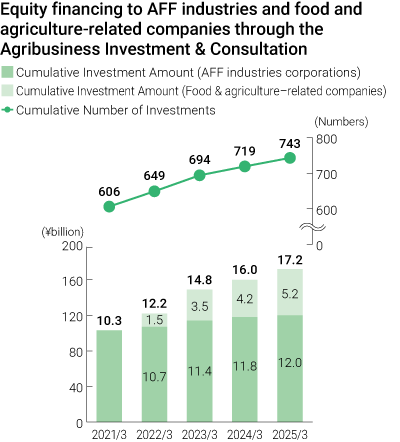
* Cumulative investments by the Bank and its Group company, Agribusiness Investment & Consultation Co., Ltd., in AFF producers, food and agriculturerelated companies, and innovation companies. Figures for prior years have been revised following a partial change in the calculation methodology in fiscal 2025.
Overview of Agriculture and Food System Development Fund
| For AFF producers | For jointly used facilities | |
|---|---|---|
| Eligible Borrowers | AFF producers pursuing growth through expansion and other initiatives | Members, organizations, corporations that fulfill an indispensable role for local AFF industries |
| Use of Funds | Capital expenditure, working capital, etc. | Capital expenditure for jointly used facilities |
| Financing terms and conditions | Favorable loan terms and interest rates compared with typical conditions | |
| Lending | facility Total: ¥100bn (*including existing lending facilities) | |
Support for export growth
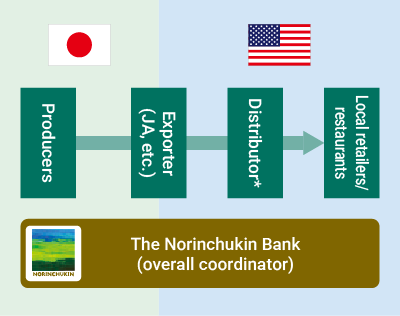
In the United States, where connections with distributors are critical, the Bank acted as a bridge to arrange a Wagyu beef export project to the U.S., supporting not only export growth but also greater brand recognition and demand creation for Wagyu among local restaurants and other businesses in the U.S. Going forward, we will continue to promote exports in collaboration with the JA Group by leveraging the Bank's overseas network.
* Indicates businesses involved in wholesale and distribution in the US
Carbon Credit Business
To contribute to sustainable food and AFF systems, we launched a carbon credit intermediation service specializing in domestic AFF industries in fiscal 2023. By the end of fiscal 2025, we had intermediated approximately 170 thousand tonnes*.
Additionally, in collaboration with the JForest Group, we have launched a transaction platform to support the creation and sale of forest carbon credits called FC-BASE. Since its launch in March 2024, multiple transactions have been concluded via this platform.
*1 Includes expected volumes under long-term sales agreements.
Location where carbon credits supported by the Bank were generated
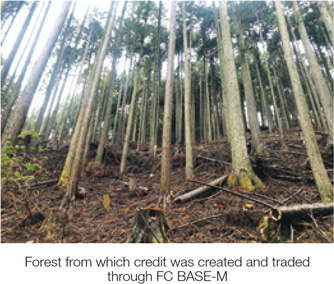
Forest in Hakone and Yugawara, Kanagawa Prefecture
Forest-based credit platform


Food & agriculture business open innovation
AgVenture Lab (hereinafter, “AgLab”), a general incorporated association established by eight JA Group organizations nationwide, promotes open innovation aimed at addressing social issues related to food, agriculture and lifestyles. In addition to supporting operations, the Bank’s Food & Agriculture Business is also working closely with AgLab.
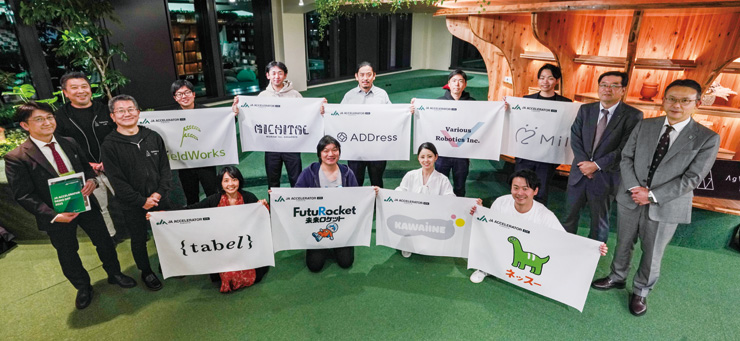
Since fiscal 2019 JA Accelerator has been supporting start-up companies involved in addressing social issues. Selected companies work to create new value and provide services in collaboration with the JA Group, while receiving hands-on support from JA Group employees over a half-year period. As the seventh term of the JA Accelerator Program, nine companies were selected from 189 applicants in fiscal 2025.
JA Accelerator Program: selected startups (7th term)
Number of selections
| Cumulative Total (Terms 1–7) | |
|---|---|
| Number of applications | 1,328 |
| Number of selections | 61 |
Current Challenges and Direction of Responses for Fiscal 2026
Current Challenges
- AFF industries are facing a range of challenges, including the decline in agricultural land and producers, as well as persistently high input costs. Achieving sustainable AFF industries will require not only support for upstream production, but also solutions across the entire value chain, including midstream and downstream segments, such as the rationalization of aging infrastructure and promoting consumer understanding of price formation.
- To address these challenges, cooperative organizations must further strengthen their integrated capabilities to provide both financial and non-financial solutions, leveraging the collective strengths as a cooperative, to support higher productivity and value creation among AFF producers and related industries.

Direction of Responses for Fiscal 2026
- Maintain and strengthen the production base
- The Norinchukin Group will promote scale-expansion and sophistication of AFF producers’ operations, while sharing roles among JA and JA Shinnoren , utilizing the Group's unique investment and lending programs (dedicated financing for large-scale producers and jointly used facilities) and Agricultural Modernization Funds, and providing consulting activities for AFF leaders.
- Strengthen and optimize the food and agriculture value chain
- The Group will work to strengthen and optimize the entire food and agriculture value chain through initiatives such as supporting business restructuring and business succession using the Groups’ M&A advisory function, investing in innovation companies in areas such as agritech and foodtech, and promoting production-region development and exports to address the challenges faced by each industry.