Pursuing stable profit as the ultimate manager of funds for JA Bank and JF Marine Bank
The ultimate goal of the Investment Business is to return profits to our members by efficiently managing JA Bank’s and JF Marine Bank’s funds based on “Globally Diversified Investment” and “Leveraging our Scale Advantages” as keywords.
We invest across a wide range of assets, including not only traditional stocks and bonds but also securitized products like CLOs* and alternative investments such as private equity funds, project finance, and real estate. Leveraging the specialized expertise and networks we have developed, we work to capture attractive investment opportunities and enhance performance under appropriate risk management.
To further strengthen its earning power, the Bank will seek to improve risk-return profiles through agile rebalancing considering market conditions, while also working to develop medium- to long-term revenue sources through the expansion of its asset management business and strategic investments. Furthermore, our business is committed to sustainable finance through investments in products that contribute to climate change mitigation and biodiversity conservation.
* Collateralized Loan Obligation
USHIKUBO Katsuhiko
Director and Senior Managing Executive Officer
(in charge of Global Investment and Banking)
Member of the Board of Directors
Chief Investment Officer
What is the Investment Business?
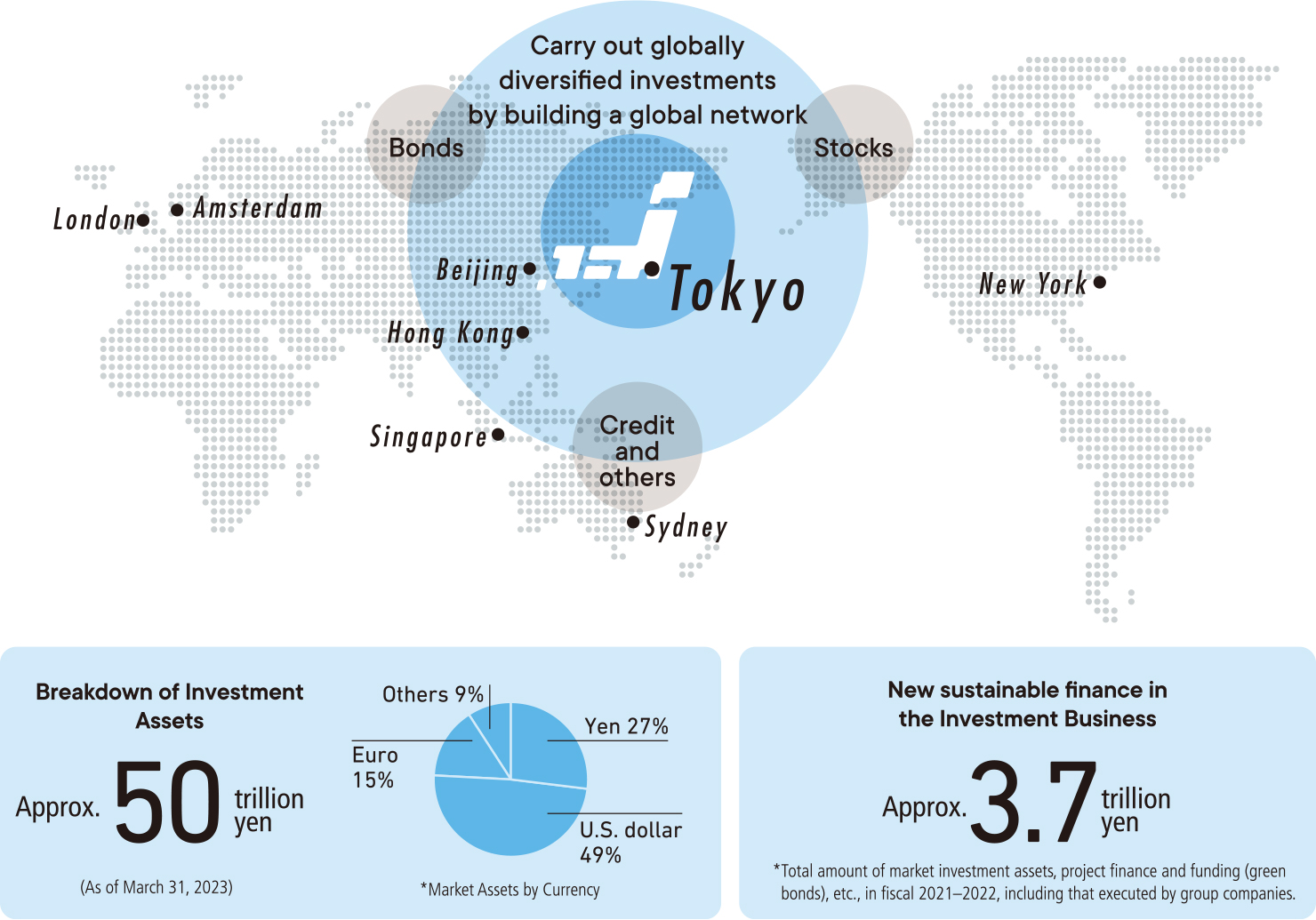
Our Investment Business aims to continuously return to members the profits gained from globally diversified investments using funds received from members and asset management business with Group companies.
Overview of the Investment Business
* Assets under management
Main Initiatives in Fiscal 2025
Portfolio management targeting stabilized returns over medium-to-long term
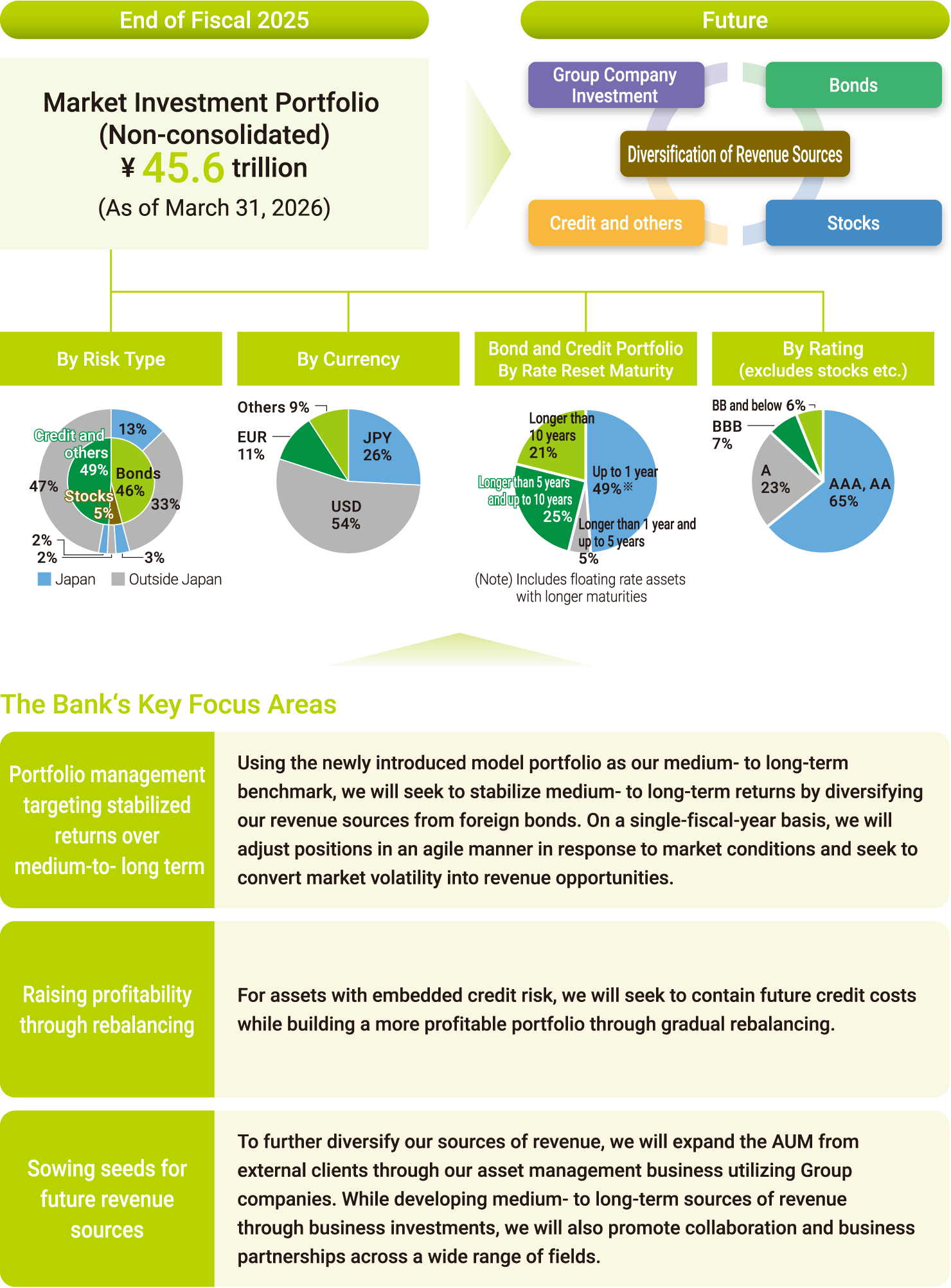
In fiscal 2025, we steadily advanced new investments and loans while maintaining a prudent stance, resulting in an increase in the market investment portfolio balance to ¥45.6 trillion as of the end of March 2026 (up ¥5.3 trillion year-on-year). In addition, the net unrealized loss on securities improved to ¥219.9 billion as of end March 2026 (up ¥330.1 billion year-on-year), reflecting an improvement in unrealized gains on stock, credit and others.
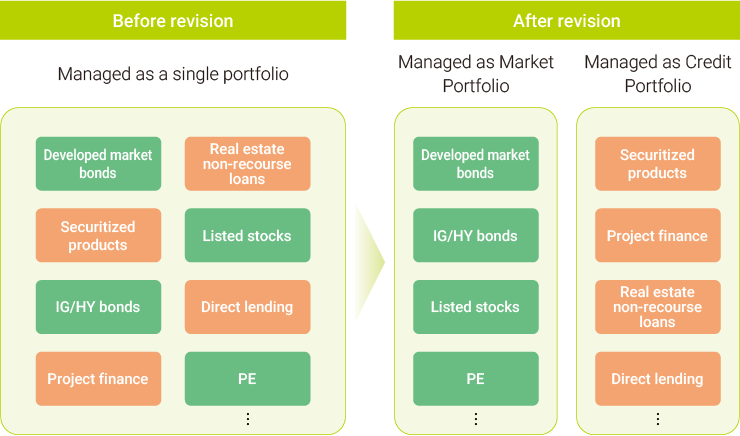
In addition, we established a portfolio management framework that classifies assets into “market assets” and “credit assets” based on their characteristics. Specifically, the management and investment of market assets (the Market Portfolio) includes not only highly liquid assets (developed market government bonds, mortgage-backed securities, investment-grade (IG) corporate bonds, high-yield (HY) corporate bonds, and listed stocks), but also less liquid assets expected to generate returns through changes in market value, such as private equity (PE) and hedge funds. Meanwhile, for credit assets (the Credit Portfolio), we have established a framework for integrated management of assets that generate stable income and are less susceptible to market fluctuations, including project finance and securitized products (CLOs, RMBSs*), while maintaining a focus on containing credit costs.
In addition, we have introduced a model portfolio that emphasizes a medium- to long-term balance between risk and return, and are promoting the diversification of revenue sources from foreign bonds based on this framework. We will continue to make adjustments to the model portfolio itself to stabilize returns over the medium- to long-term.
* Residential mortgage-backed securities
Revised portfolio management
Improved profitability through rebalancing
In fiscal 2025, we further advanced the diversification of our revenue sources, building on the initiatives conducted in the previous fiscal year. With the aim of rebalancing interest rate risk assets and non-interest rate risk assets, we expanded our exposure to equity assets, including listed stocks, while also increasing credit risk assets.
In addition, we promoted asset diversification as well as diversification by region, maturity and investment timing, in order to generate stable profits over the medium- to long-term. While the Bank has long pursued Globally Diversified Investment, we will continue to take on the challenge of further enhancing our globally diversified investment approach through ongoing reviews of our investment methods and risk management, aiming to further stabilize earnings over the medium to long term.
What Is the Globally Diversified Investment We Aim For?
With the ultimate goal of steady investment returns for our members, we have diversified our investment portfolio globally since 1998, leveraging our scale to invest efficiently and make the best use of global financial markets.
After carefully examining the wealth of information obtained from our global network, including our overseas branches and subsidiaries, instead of concentrating investments in limited markets or assets, we target investments across a wide spectrum of markets and assets with different risk–return characteristics, thereby managing the overall risk of our portfolio.
Sowing Seeds for Future Revenue Sources
In April 2025, we established a dedicated department (the Business Development & Strategic Investment Division) to further expand our asset management business by supporting Group company growth, and to advance strategic business investment initiatives, seeking to develop medium- to long-term sources of revenue.
Asset Management Business
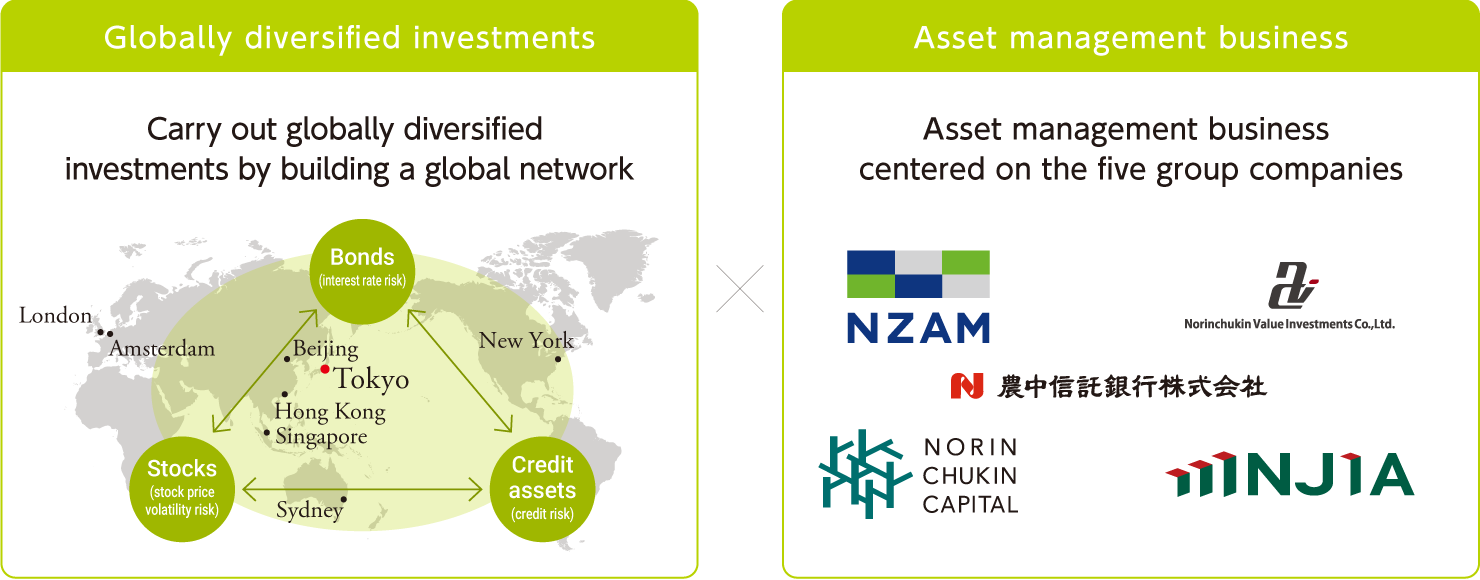
In our asset management business, with a view to capture external revenue opportunity and provide investment opportunities to cooperative organizations, the core group company Norinchukin Zenkyoren Asset Management offers a full lineup of asset classes and provides solutions tailored to customer needs. In addition, The Norinchukin Trust & Banking, Norinchukin Value Investments, Norinchukin Capital, and Nochu-JAML Investment Advisers each provide high-quality investment opportunities and businesses that leverage their respective strengths.
What is our Asset Management Business?
With the goal of fulfilling the Bank’s Purpose, our Asset Management Business aims to grow and stabilize investment revenue through diversification of revenue sources by acquiring management fees that are less vulnerable to economic fluctuations. To leverage our extensive investment experience and meet our customers’ diverse requirements, we have developed our Asset Management Business with the five group companies listed below as the core.
Initiatives of Group Companies
| Group companies | Product offerings | Customers | Overview and main initiatives during fiscal 2025 |
|---|---|---|---|
|
Norinchukin Zenkyoren Asset Management Co., Ltd. 
|
Government bonds,listed stocks, credit, alternative investments |
Institutional investors |
|
|
The Norinchukin Trust & Banking Co., Ltd. 
|
Fund management, trust products, etc. |
Institutional investors |
|
|
Norinchukin Value Investments Co., Ltd. 
|
Listed stocks |
Institutional investors |
|
|
Norinchukin Capital Co., Ltd 
|
Growth and buyout investments, corporate venture capital (CVC) |
Institutional investors |
|
|
Nochu-JAML Investment Advisors Co., Ltd. 
|
Private REIT with domestic focus, funds |
Institutional investors |
|
Strategic business investment
In November 2025, we entered into a basic agreement on a capital and business alliance with SBI Shinsei Bank. The objective is to promote comprehensive collaboration in areas including investment, lending and food & agriculture by combining the investment solutions and food & agriculture business expertise built up through our Globally Diversified Investment approach with SBI Shinsei Bank's advanced IT and digital technologies and diverse financial solutions.
Through this alliance, we aim not only to strengthen the Norinchukin Group's asset management business and enhance profitability by responding to diverse investment and lending needs, but also to promote DX across the agriculture, fishery, and forestry (AFF) industries and local communities.

Current Challenges and Direction of Responses for Fiscal 2026
Current Challenges
- Against a backdrop of political developments, monetary policy trends and heightened geopolitical risks across countries, market conditions are characterized by elevated uncertainty and volatility. As a result, fluctuations in the value of market risk assets are having a greater impact on profitability and the financial base, making the diversification of revenue sources and the strengthening of risk resilience through more sophisticated portfolio management key management challenges.
- With the progression of a K-shaped economy, business transformation driven by AI and the emergence of geopolitical risks, uncertainty in the market environment is increasing, and meaningful differences are emerging in the performance of credit risk assets and asset managers. Accordingly, it is even more necessary to accurately identify underlying risks, optimize the balance of investment assets, and continuously secure returns commensurate with the costs incurred. One particularly important challenge is maintaining and expanding stable carry income that is less susceptible to changes in the operating environment.
- With respect to the asset management business, while continued growth is expected across the industry as a whole, competition for AUM is becoming increasingly intense. We recognize that differences in product competitiveness, investment capabilities and service quality will increasingly determine competitive advantage.

Direction of Responses for Fiscal 2026
- We will further advance the diversification of revenue sources through continued improvements in our portfolio. At the same time, even during periods of sharp changes in financial markets, we will seek to improve the profitability of market risk assets through active position adjustments that reflect market conditions and risk characteristics, while appropriately controlling risk, thereby enhancing the sustainability of our financial and earnings base.
- We will further refine comparative analyses of the profitability and risk characteristics of individual asset classes and optimize the allocation of capital and liquidity resources through asset diversification based on asset characteristics and the sources of risk. In doing so, we will clarify risk-adjusted profitability while promoting reallocations toward assets with intrinsically higher returns.
At the same time, we will enhance controllability and implement credit portfolio management that can be flexibly adjusted in response to market fluctuations and structural changes, thereby establishing a stable and sustainable carry-income base. - We will strengthen the competitiveness of each Group company through the ongoing expansion of product lineups and the review and enhancement of existing products. At the same time, by optimizing functions across the Norinchukin Group and promoting business alliances, we will continue our efforts to expand Group-wide assets under management and earnings.