Human Resources Strategy

The power of each proactive individual is the driving force that shapes our future.
Human Resources Management

Basic approach to human resource management

As business environments, work styles, and values undergo rapid changes, the Bank is transforming itself into an organization where employees can independently hone their expertise and play active roles. To this end, we have established the following HR management policy.

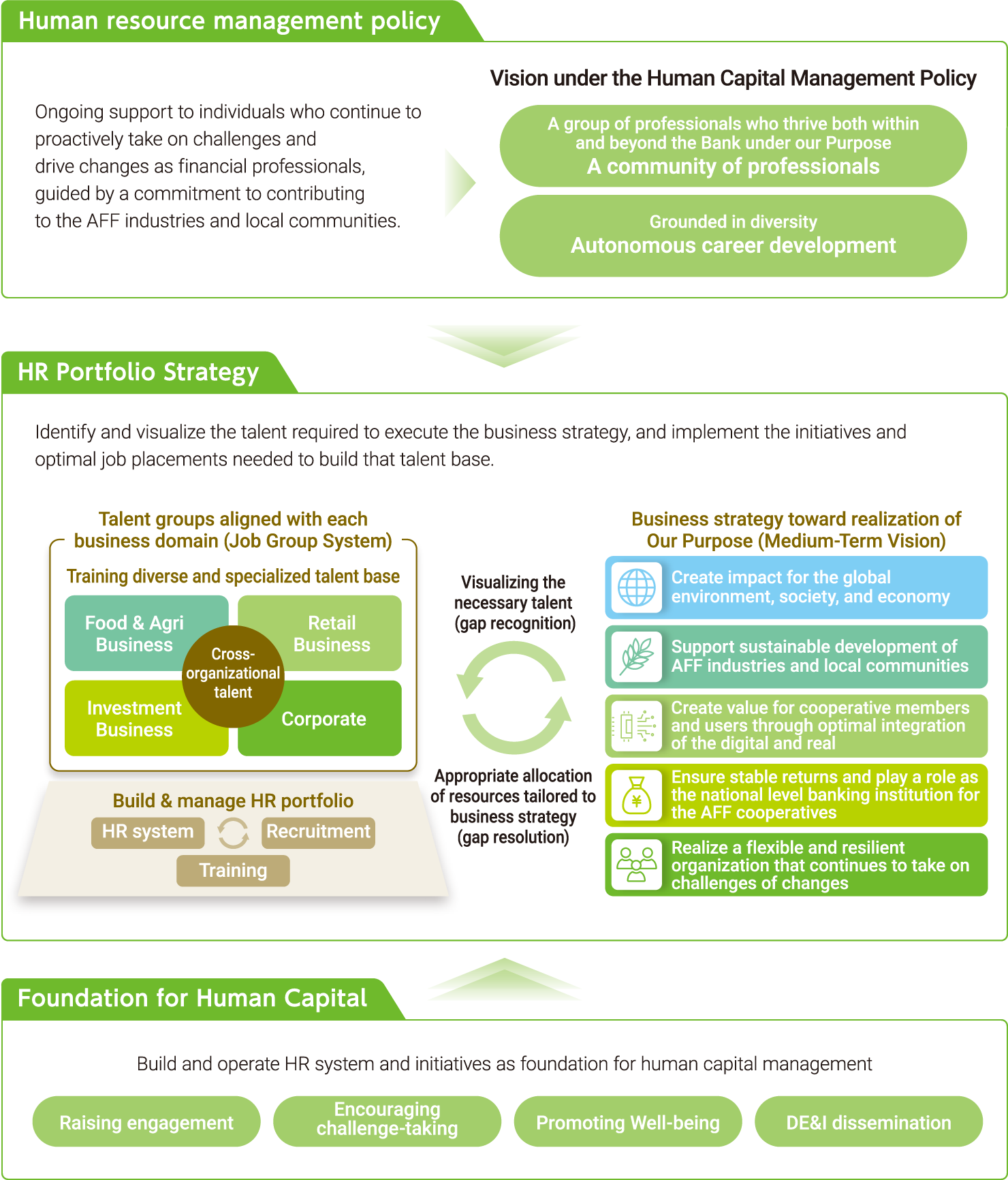
Human resource management policy Ongoing support for human resources who continue to autonomously take on challenges and make changes as financial professionals with a sense of contributing to the AFF industries and local communities.

Introduction of Job group system

Based on our HR management policy, we have established a personnel system that features the concepts of “autonomy” and “expertise.” As part of this system, we have introduced job group classifications defined by such questions as, “What kind of value?”, “For whom?”, and “How to provide it?”
Under the job group system, employees register themselves in work categories based on their preferences and experience and, as a general rule, are assigned to work in groups that they chose to develop expertise over the medium to long term.
In addition to job rotation driven by job groups, we have established group job descriptions that explain job groups in detail, defined required expertise by function and job level, and introduced job competencies as discrete units for evaluating and developing expertise. Through regular 1on1 meetings, evaluations, and feedback with supervisors, we support the development of employees' specialized skills.

Job group system

The diagram shows the flow of job group registration and transfers categorized by career hierarchy (from Associate to Manager) and job categories.

CC: Cooperative Central Banking; GI: Global Investments; BE: Business Expert

* CC: Operates the Retail Business as the central bank for the JA Bank / JF Marine Bank System; Domestic Branches: Operates Food and Agriculture Business and Retail Business within local communities; BE: Provides support for planning and front-office operations and handles business development, application and optimization

Human resource portfolio strategy

We have put together a strategic human resource portfolio framework for developing the workforce necessary to successfully implement our business strategy.
Through the job group system, we define, in terms of job competencies, the kinds of expertise necessary to achieve our business objectives and catalogue the expertise of our employees through competency assessments.
We also focus on attracting and developing key cross-organizational staff who can support future growth. Examples include overseas business talent, DX talent, IT/digital talent, and sustainability talent. In this way, we promote systematic investment in human capital.

Linking human resource strategy and business strategy

A diagram illustrating the alignment between the Bank's human resource strategy and business strategy (the Medium-Term Vision).

* Targets shown in the above chart are for fiscal 2030. Please refer to the following pages for details on initiatives for developing and recruiting the above types of staff.

Current Challenges and Direction of Responses

Human resource development initiatives

We are implementing various measures in line with the themes of cultivating expertise within job groups and developing cross-organizational talent. Our investment in human resource development provides learning opportunities for our employees, builds a suitable human resource portfolio, and improves employee engagement.

This is a conceptual diagram of the Bank's human resource development. Additionally, the training investment for the fiscal year 2024 is 783.9 million yen, which amounts to 230,000 yen per person.

Fostering expertise within job groups

As a component of job group management, we are fostering expertise by strengthening the training system for each job group.
For example, in the Food & Agriculture Group, we are promoting human resource development through training based on experience and knowledge cultivated in lending operations and on-the-job training through practical experience in the field. We expect these efforts to improve profitability and create value for stakeholders. Our training program offers a range of courses tailored to the participants’ level of experience, from learning the basics of lending operations to practical training in pitching sales proposals aimed at solving management problems for customers.

Cross-organizational talent development

(1) Leadership and management training

In order to steadily advance staff development based on our HR management policy, it is important for leaders and managers to fulfill their roles. We have established a training system tailored to each job level to enable employees to acquire the leadership and management skills they require along with effective communication skills for developing subordinates. In addition, we are working to ensure that training is not just an one-time event, but rather a continuous process through training programs that are linked to actual work in the workplace.

A hierarchical diagram showing the training content categorized by level (from Associate to Manager).

(2) Encouraging diverse experiences and ways of thinking

To assemble a group of professionals with diverse ways of thinking and provide opportunities to encounter ideas, values, and work styles that cannot be obtained within the bank, we are promoting cross-disciplinary training (learning and collaborative value creation together with employees from different industries as well as work experience in fields beyond the scope of one's own organization). In fiscal 2024, 25 employees participated in this program.

A diagram explaining that there are two types of cross-disciplinary training : the Dual-career model, which involves dispatching to startup companies, and the Inter-industry exchange, which involves dispatching to business schools and similar institutions.

(3) Autonomous career development

To help self-directed career development, we provide employees with support for skill enhancement and reskilling, as well as career autonomy support, regardless of professional course (job class). In fiscal 2024, we established a new company internship program to allow employees to try out and deepen their understanding of business areas beyond their experience, with the aim of promoting autonomous career development and the job group registration system.
Additionally, to provide opportunities for employees to gain overseas work experience, we offer open application to overseas training and study abroad programs (MBA, LL.M).

A diagram listing various training programs categorized into four types: Skills training, reskilling support, Career autonomy support, and Overseas training & study abroad. Additionally, 135 participants are expected to take part in company internships in fiscal year 2024, and the number of individuals who will have obtained degrees such as MBA/LL.M. by the end of fiscal year 2024 is projected to be 111. VOICE:Cross-domain training (dual-career model) Title:Learning outside of the organization I participated in this training program because I felt a sense of urgency and vague anxiety about the future. I wondered if the work I was doing was only applicable within my company, especially in an environment where autonomous career development is encouraged. At the training host company, I engaged in tasks I had never experienced before, such as
              imagining new products and considering their practical commercialization. Additionally, by placing myself outside my current organization, I could recognize not only my weaknesses but also the
              strengths I had cultivated over time. This training program made me realize that by communicating my hopes and ideas, I can take future opportunities and that a career is not only built through work but can also be shaped by private activities and chance encounters. This experience has made me more proactive about directing my own career. SOTOZAKI Tomoe Global Banking Div. VOICE:Company Internship Title:Work experience in an unfamiliar job group Through this program, I gained experience working in
              the Sendai Branch’s CC Group (a job group that covers the Retail Business). By visiting and communicating with JA, I could understand firsthand the diverse challenges faced by each region. In addition, I was able to experience some of the challenges and rewards of promoting the financial intermediary function of JA Bank by The Norinchukin Bank's formulating strategies and supporting initiatives while, respecting the autonomy of each JA. In my regular role within the Food and Agriculture Group, I am involved in lending to distant-water fishermen and the national-level organizations of JF Group. However, this opportunity to work in a new business area allowed me to take stock of my future as an employee of the Bank and identify areas where I would like to develop my strengths. This experience has given me valuable insight and motivated me to proactively plot my career path. SHUTO Koki Food & Agri Banking Div.

(4) Cross-organizational staffing

We are working to develop a cross-organizational team to achieve our Vision for 2030 as described in our Medium-Term Vision. This includes the development of DX and IT/digital talent and the promotion of sustainability, diversity, equity, and inclusion.

Recruiting initiatives

We are working to strengthen our midcareer recruiting effort and increase our hiring quota in order to build a diverse group of highly skilled professionals who bring a variety of perspectives.
To strengthen midcareer recruiting, we have introduced an employee referral system and are working to clarify and conceptualize the specific expertise required for each related position and help expand recruiting within each business area. In addition, for new graduates, we have introduced a course-based recruitment system that specifies the department of initial assignment for candidates who wish to develop specific expertise. We have also established a system based on exclusive recruiters to reduce recruitment mismatches.

A graph showing the trends in recruitment results. The data is presented in the following order: new graduate males, new graduate females, mid-career males, and mid-career females. The figures are as follows:- FY2020: 47, 43, 7, 2 - FY2021: 54, 38, 26, 7 - FY2022: 54, 62, 20, 6 - FY2023: 61, 64, 22, 6 - FY2024: 76, 86, 34, 16.
As part of our initiatives for securing talent, we have listed the systems for both mid-career hiring (career recruitment) and new graduate hiring. For mid-career hiring, we focus on specifying the required expertise, along with implementing a referral system and a Alumni reentry system. For new graduate hiring, we have a course-based system in addition to a exclusive recruiter system.

Promoting diverse work styles

To develop a diverse group of professionals with varied ways of thinking, we promote an environment in which all employees can choose work styles that fit with their distinctive life events, such as marriage, childbirth, child care, and nursing care, and where each individual can independently pursue a personally tailored career path.

Workstyle reform–related systems

Self-selected transfers Separation of job description and transfer rotation process allows employees to choose whether to transfer based on their life stage Super flex A flexible work scheduling system with no core hours enables independent and varied work styles. Spouse transfer leave This program allows employees whose spouses are transferred, to continue their careers by taking a leave of absence for a certain period. Side jobs The Bank encourages independent challenges and the acquisition of wide-ranging knowledge and skills through side jobs.

Foundation-building Management Initiatives

Promoting our corporate culture

The Bank pursues a range of measures to ensure it remains an organization with a shared sense of our Purpose and to promote the shared values that underpin our daily operations with the aim of realizing and demonstrating that Purpose. The following are some examples.

Executive seminars

Since fiscal 2019, we have held executive seminars in which one executive and a small number of employees engage in dialogue, with the goal of fostering career development awareness among employees, increasing employee engagement, and improving the organization’s culture. In fiscal 2024, a total of 156 seminars were held that were attended by cumulative 1,485 employees.

Internal public relations

To ensure that executives and employees share a sense of our Purpose and own the responsibility of achieving it, we have deployed an internal public relations portal across the entire Norinchukin Group to share examples of excellent initiatives employees have implemented based on common values as well as stories of our diverse staff performing active roles within the organization. In fiscal 2024, we posted 65 articles on the portal.

Promoting our shared value “Tackling Challenging Tasks” (an in-house entrepreneurship program)

One of our shared values is an appetite for "Tackling Challenging Tasks". Recognizing this, we have launched an in-house entrepreneurship program called Nochu Seeds to encourage our employees to accept new challenges. In fiscal 2024, we selected one project for evaluation and in fiscal 2025 began considering its commercialization.

The Logo of Nochu Seeds

Improving employee engagement

At least once a year, the Bank conducts an employee engagement survey (organizational capability survey). The results are reported to the Board of Directors. Effective response measures are subsequently considered and implemented based on analysis of the results and identification of issues.
Employee engagement scores are measured according to three factors: job satisfaction, motivation to contribute, and willingness to recommend the Bank to others.” We have set a target score of 65% or higher by fiscal 2030, based on the assumption that these factors can be raised to the necessary degree.
Recent survey results indicate individual differences in how employees perceive the direction of and changes in policies and initiatives. This implies a challenge with regard to disseminating leadership messages and suggests room for further improvement in business processes. Based on our findings, we are advancing creative initiatives tailored to realistic conditions affecting each department and branch, starting with the following section, “Ongoing initiatives to enhance engagement”.

Trend in employee engagement score FY2022:55% FY2023:54% FY2024:55% FY2030 target 65% or more Note:The three factors described above are graded on a five-point scale ranging from “strongly agree” to “disagree,” and the average percentage of positive responses to each question is calculated as the engagement score.
A diagram illustrating the cycle of 'visibility,' 'dialogue,' and 'behavior' aimed at improving employee engagement by utilizing employee engagement survey (organizational capability survey).
Ongoing initiatives to enhance engagement (examples) • Enhance the dissemination of information through internal public relations initiatives, such as strengthening information-sharing by executives • Hold executive-hosted seminars aimed at promoting dialogue with employees • Strengthen DX initiatives, such as introducing generative AI and improving systems infrastructure • Create cross-branch project teams and implement BPR* to streamline administrative operations * Business process re-engineering

Anti-Harassment Measures

To prevent sexual or power harassment as well as harassment on the basis of pregnancy, childbirth and child- or nursing-care leaves, we engage in a wide range of activities such as providing e-Learning and position-by-position education, guidance and consultation by the persons in charge of human rights issues throughout the organization, and external contacts for consultation.
We have established and are operating a harassment hotline with which employees can conduct individual consultations, and are seeking to ensure a broad awareness that employees can quickly access the harassment hotline whenever they need to. Further More, we strive to protect the privacy of the persons concerned and to take prompt action.
So that we can ensure psychological safety in the workplace, we are focusing our initiatives on preventing harassment and strengthening the harassment hotline function.

Occupational Health and Safety

The Norinchukin Bank engaged in developing working environments where employees can perform their duties in good health and with a sense of security.
Our health management policy is formulated each year by the Occupational Hygiene Committee. This policy prescribes measures to be taken to reinforce the management of the physical and mental health of employees and help promote their health.
While ensuring that all employees take regular health checkups, we urge their families to take health checkups as well. According to the results of these checkups, health guidance is provided by industrial doctors and medical staff. Efforts are also being made to reduce working hours, considering the possible adverse impact of long hours of labor on employee health.
As part of its efforts to ensure mental health at the workplace, we advise self-care methods for employees, offer counseling and other consultation opportunities, and conduct position-by-position mental health education. In addition, we carry out stress checks, offer readily available self-checking functions and have the Mental Health Consultation Room in place to provide consultations as required at the medical office in the head office of the bank.
To increase the health consciousness of employees and establish the practice of doing moderate exercise on a regular basis, we offer a wide range of educational programs and welfare services. Specifically, we subsidize sports club memberships and have health leaders lead health promotion activities.

Labor Relations

The Norinchukin Bank has an employee union as a counterpart organization to its management. In addition, this employee union employs a union shop system. As a general rule, all employees become union members on joining the Bank.
Our employee union has the authority to negotiate with management on important matters such as the maintenance and improvement of labor conditions for its members. Furthermore, surveys are conducted with members to aid in negotiation with management, and forums have been established for offering various recommendations to management. For any changes in personnel and labor-related systems that would exert significant impact on the lives and work styles of union members, management is required to come to an agreement with the employee union, whether through the management committee, the labor committee or other negotiations.

pagetop