Turning change into strength, enhancing earning power through continuous challenges and contributing to the sustainable development of agriculture, fishery and forestry industries.
One year since appointment as CEO Making steady changes, step by step
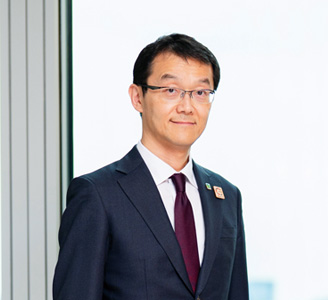
Since assuming the position as CEO in April 2025, I have focused on three main themes: "rebuilding earning power," "contributing to the sustainable development of agriculture, fishery and forestry (AFF) industries," and "reestablishing trust from stakeholders." I have steadily worked step by step on these priorities. Before summarizing the developments to date, I would like to share some reflections on my first year.
Although it is something I had anticipated, creating meaningful change requires a considerable amount of time. Specifically, there are three aspects: First, the time between laying the groundwork and seeing results — AFF and local communities inherently operate on a large scale, requiring a patient and dedicated approach.
Second, the time needed for the organization to shift its direction —a process of genuine understanding among all officers and employees of the undergoing changes, builds the organization’s fundamental strength.
Third, the time to deepen mutual understanding with our customers — It is essential that we continue to demonstrate our own transformation for our customers to truly feel that "The Norinchukin Bank can support" with challenges that each customer is facing.
Of course, the external environment is changing relentlessly. From the emergence of geopolitical risks to day-to-day change in the global financial and economic situation, which are also impacting Japan’s AFF industries. Furthermore, technological innovations such as generative AI are advancing remarkably, presenting both opportunities and threats. To appropriately adapt to these environmental changes and continue providing value to our stakeholders, I believe it is important not to rush on short-term results but to steadily build on our initiatives.
I have seen gradual changes within our organization. Employee engagement surveys show a steady growth in the number of employees who positively view the Bank's future and the work they perform. Members of the Supervisory Committee have also remarked that "the organizational atmosphere has started to change." Since my appointment as CEO, I have consistently conveyed the same messages to all our officers and employees: “Let’s move forward with confidence and optimism,” “Let’s learn from outside rather than turning inward,” and “Let’s value small challenges in our day-to-day work.” I am confident that consistent communication of these words will become the driving force for our organization.
“Earning Power” and “Development of AFF Industries” Focusing on Medium-to-Long Term Outcome
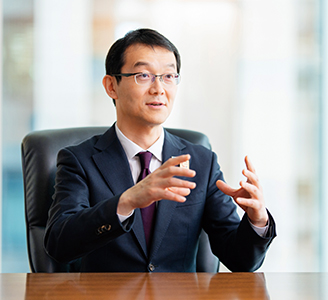
As an outcome of these continuing efforts, the Bank returned to positive profit in fiscal 2025. I would once again like to express my sincere gratitude to our members for the various forms of support, including capital enhancement, provided in response to the loss recorded in fiscal 2024.
It is important for the Bank to continue diversifying revenue sources to "Rebuild earning power" - in other words, continue to secure stable profits. We have sincerely reflected on past experiences and lessons learned, and as an organization, we share the commitment to continue diversification regardless of how future circumstances may change.
We have steadily worked on this approach, without becoming overly focused on short-term profit targets. Although we are still at an early stage, we are conducting new investments, while carefully assessing risk and return, and promoting initiatives to leverage group companies to diversify revenue sources across the entire group.
While each of these changes may be relatively small from the overall scale of the Bank, I firmly believe that the accumulation of these small efforts will lead to a sustainable and more robust profitability base.
To contribute to the sustainable development of AFF industries, we have further strengthened our approach to the entire food and agriculture value chain. Starting with the organizational reform of the division responsible for the food and agriculture business, we reinforced both our structure and means. We established a new proprietary loan program totaling ¥100 billion —combined with existing frameworks— to support the expansion and scaling-up of AFF producers and restructuring of aging shared-use facilities. Additionally, we increased the number of employees in charge of agricultural lending by 10%. We have also actively engaged in proposals related to M&A and corporate value enhancement that encompass the entire value chain, challenging ourselves to further advance the solutions we offer to AFF producers.
In fiscal year 2026, we will continue to steadily advance our efforts toward "rebuilding earning power" and "contributing to the sustainable development of AFF industries" and thereby "reestablishing trust from stakeholders."
To achieve these priorities, we believe it is crucial for us to clearly communicate to our stakeholders what we are aiming for, what actions we are taking, and what changes we are seeking to create. The publication of this Integrated Report is one part of these communication.
As I emphasized in this message, for the three priorities, I intend to manage the Bank with a focus on delivering solid results over the medium-to-long term, while adapting to short-term changes, as these priorities would not be accomplished overnight.
Supported by Reforms to The Norinchukin Bank Act The Next Stage of Contribution to AFF Industries
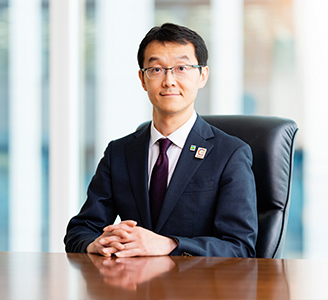
In April 2026, the Norinchukin Bank Act was amended.
There are three main points in this revision.
First, the Bank's lending function for the AFF industries was strengthened. Article 1 of the Act, which sets out the Bank's purpose, now explicitly includes members of cooperative organizations (AFF producers) as targets for facilitating finance. In addition, lending and related services for AFF producers, which were previously classified as discretionary activities, are now designated as essential functions.
Second, the Bank's equity financing function was strengthened. Equity financing procedures were eased, enabling the Bank to make more active equity financing to AFF producers and related businesses.
Third, restrictions on holding concurrent positions were relaxed, enabling the Bank to appoint external experts to its Board of Directors.
I view these amendments as a “legislative support for the direction The Norinchukin Bank has been already pursuing.” The AFF industries are facing a major turning point, with multiple challenges including a declining number of AFF producers, persistently high input costs, and escalating geopolitical tensions. I believe the amendments reflect the expectations for the Bank to play an even greater role in this period. As we review the initiatives undertaken to date, we will reconsider what is still lacking and what should be further enhanced, and further accelerate our initiatives.
With respect to strengthening lending and equity finance for the AFF industries, the respective roles and the close coordination between the JA Bank - JA, JA Shinnoren, and the Bank - will remain unchanged. However, as consolidation and scaling-up continue across the agricultural sector, we expect to see a growing number of opportunities where the Bank is uniquely positioned as a national-level institution can provide support. I also believe that the enhancement of our equity financing function will become a significant means to clearly demonstrate our commitment to sharing risks and supporting the sector during this period of transformation in the AFF industries.
We will vigorously promote initiatives that combine financial and non-financial support, including strengthening consulting capabilities, supporting digital transformation (DX) in the AFF industries, providing support across the entire value chain, and accompanying innovative companies in fields such as agri-tech and food-tech. By centering on finance and bringing together various players, we aim to take on the role of jointly addressing sustainability challenges in the AFF industries.
Following the recent amendments to the Norinchukin Bank Act, we promptly appointed two external experts as Board of Directors. While we have previously incorporated insights of external experts through the Financial Strategy Committee, adding objective and professional perspectives directly to the Board of Directors—distinct from directors appointed from the Bank—further enabled us to establish a system capable of making management decisions from a multifaceted viewpoint.
At the same time, the perspectives of JA, JF and JForest as a cooperative organizations that are close to local communities remain as important as ever. It is essential to carefully advance the process of discussion by blending external viewpoints with those of the cooperative organization, with a shared commitment to improve the AFF industries and local communities. Ensuring that this structure functions smoothly will enhance the quality of the Bank's management and enable robust decision-making as we pursue our fundamental mission of contributing to the AFF industries while maintaining sound profitability.
Still “One-Third” of the progress in our Medium-Term Vision Building on our Progress to Full-Scale Implementation
We have formulated our Medium-Term Vision “Nochu Vision 2030," which sets out our ”visions” for 2030, and are promoting initiatives to realize them. Two years have passed since the launch in fiscal 2024, and my candid assessment is that we are “only about one-third of the way up the mountain.” While the progress made under each of the theme under the Vision is discussed later in this report, overall, we are building a solid foothold toward reaching our destination although there is still some distance from the top of the mountain. Over the past two years, we have concentrated our management resources on our financial position as our highest priority.
From here, we enter a new stage to fully accelerate our efforts in each theme of the Medium-Term Vision. I also feel a definite change within the organization, as each officer and employee are stepping out of their comfort zone and embracing action under new ways of thinking.
Fiscal 2026 also marks the midpoint of the Medium- Term Vision. As the world continues to change, we take this opportunity to reflect deeply on the progress made over the past two years. While discussing what is really necessary today and reconsidering our path forward, we intend to sincerely revisit the question “What do we want to have achieved by 2030?” and strengthen our commitment to make the most out of the next four years.
As an underlying issue for rebuilding earning power and contributing to the sustainable development of AFF industries, I recognize that addressing sustainability issues, including climate change, is both inevitable and urgent. While we are advancing initiatives across the entire organization in this area, The Norinchukin Bank cannot address these challenges alone. We are therefore working to advance these efforts in close cooperation with diverse stakeholders including our members, customers, government agencies, academia, and other financial institutions.
In addition, the Bank serves as the national organization for both JA Bank and JF Marine Bank and provides various financial functions to help JA and JF to appropriately meet the financial needs of their members, customers and local communities. Currently, we are advancing initiatives aimed at delivering even greater value to JA and JF members and customers. These include enhancing and expanding digital infrastructure, particularly through the improved application-based banking functions, as well as planning nationwide initiatives designed to maintain and strengthen the business foundation for the future.
To ensure the steady advancement of these initiatives, it is essential for us to strengthen the foundation of the organization itself. At the core, I believe people are the foundation. In recent years, interest in human capital management has been growing. The Bank also recognizes under the Medium-Term Vision that creating an environment where each officer and employee can proactively take on challenges and fully demonstrate their potential will be a key driving force in steadily moving forward the Bank’s initiatives.
Recognizing The Norinchukin Bank’s Unique Strengths Building Business for the Next 100 Years
As I mentioned in last year's message, the most distinctive feature of the Bank is that we are a financial institution within a cooperative organization based on “mutual benefit,” representing the values and principles that define the reason for our existence.
Furthermore, as specified in the Norinchukin Bank Act, our mission is clearly defined as “contributing to the sound development of the AFF industries and the advancement of the national economy.” Thanks to this mission, we can pursue our business from a long-term perspective without being swayed by short-term environment changes. Furthermore, our stable funding base established through longstanding relationships of trust with our members, including JA, JF and JForest, is the foundation that allows us to pursue long-term and diversified asset management. This stability is what enables us to provide steady and continuous support to the AFF industries and local communities.
The integrated operation of our cooperative system like the JA Bank and JF Marine Bank, as well as the experience and trust built over more than 100 years by overcoming numerous challenges together with our members, are also invaluable assets for us.
Of course, in order to continuously demonstrate these strengths, the organization itself must continue to evolve.
While leveraging the strengths of a stable organizational culture, at the same time, it is essential to actively incorporate diverse perspectives and flexible ideas.
I believe that striking this balance is precisely what would be required of us and is the key to further strengthening our strengths. In other words, I think that all officers and employees are expected to move forward while balancing "stability and flexibility," "homogeneity and diversity," and "tradition and innovation," especially in an era of discontinuity.
It is also important to look across the entire group and continually ask where and how we can generate profit in ways that benefit AFF producers and local communities.
With a long-term view toward diversifying revenue sources across the entire cooperative system, we will continue to question ourselves ―“What is a thing that only the Norinchukin Bank can do?” ― and consciously cultivate new strengths for the Bank’s next 100 years.
Over the past year, in meeting many people, I have heard unanimous expectations for the Bank and the cooperative organizations. I have once again come to realize the significance of my social responsibilities, including those within the cooperative system, and each time I have a renewed sense of responsibility and dedication.
The AFF industries are facing structural challenges, including a declining number of producers and shrinking regional populations. However, I sense a growing positive awareness among the stakeholders of JA, JF, and JForest about “What more can be done to improve?” I see this as a great opportunity. As a national-level organization, we will proactively work to further enhance the division of roles and functions across the entire cooperative system so that we can deliver even greater collective strength. This includes identifying and creating the unique value we can provide, contributing through our products and systems capabilities, and engaging in diverse ways that leverage the distinct characteristics of each region.
A stable supply of food is the core of national security, and supporting this effort firmly through the power of finance is the pride and raison d'être of The Norinchukin Bank as a cooperative financial institution.
Dedicated to Our Mission
The mission of The Norinchukin Bank has remained unchanged since its establishment more than 100 years ago: to support the sustainable development of the AFF industries. With all our officers and employees returning to this original foundation, the Bank will move forward on "rebuilding earning power" and "contributing to the sustainable development of AFF industries." We recognize the early resumption of dividend payments as a key promise to our members and will make every effort to realize it as early as possible.
The AFF industries are facing a major turning point, and expectations for the Bank and its role are greater than ever. We remain fully committed to our mission of supporting a stable food supply and the sustainable development of local communities.
Building on the strengths we have cultivated over the years and consciously creating new ones, we are determined to build the next 100 years with confidence and purpose. We will devote our utmost efforts, united as one team, to ensure that our stakeholders can clearly see that “The Norinchukin Bank is steadily moving forward” and to earn even greater trust as early as possible.
We sincerely appreciate your continued support and encouragement.
July 2026
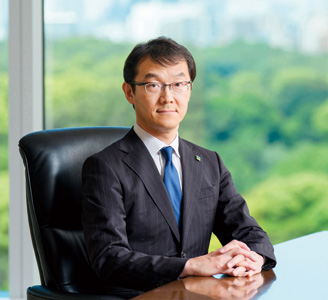
KITABAYASHI Taro
Representative Director and President
Chief Executive Officer
The Norinchukin Bank